
Every litre, counted twice.
Fruit uses water in the field and again on the line. In a country as water-constrained as Egypt, a sustainability page that skips this section is not worth reading.
 Primary goal · Goal 6Clean water and sanitation
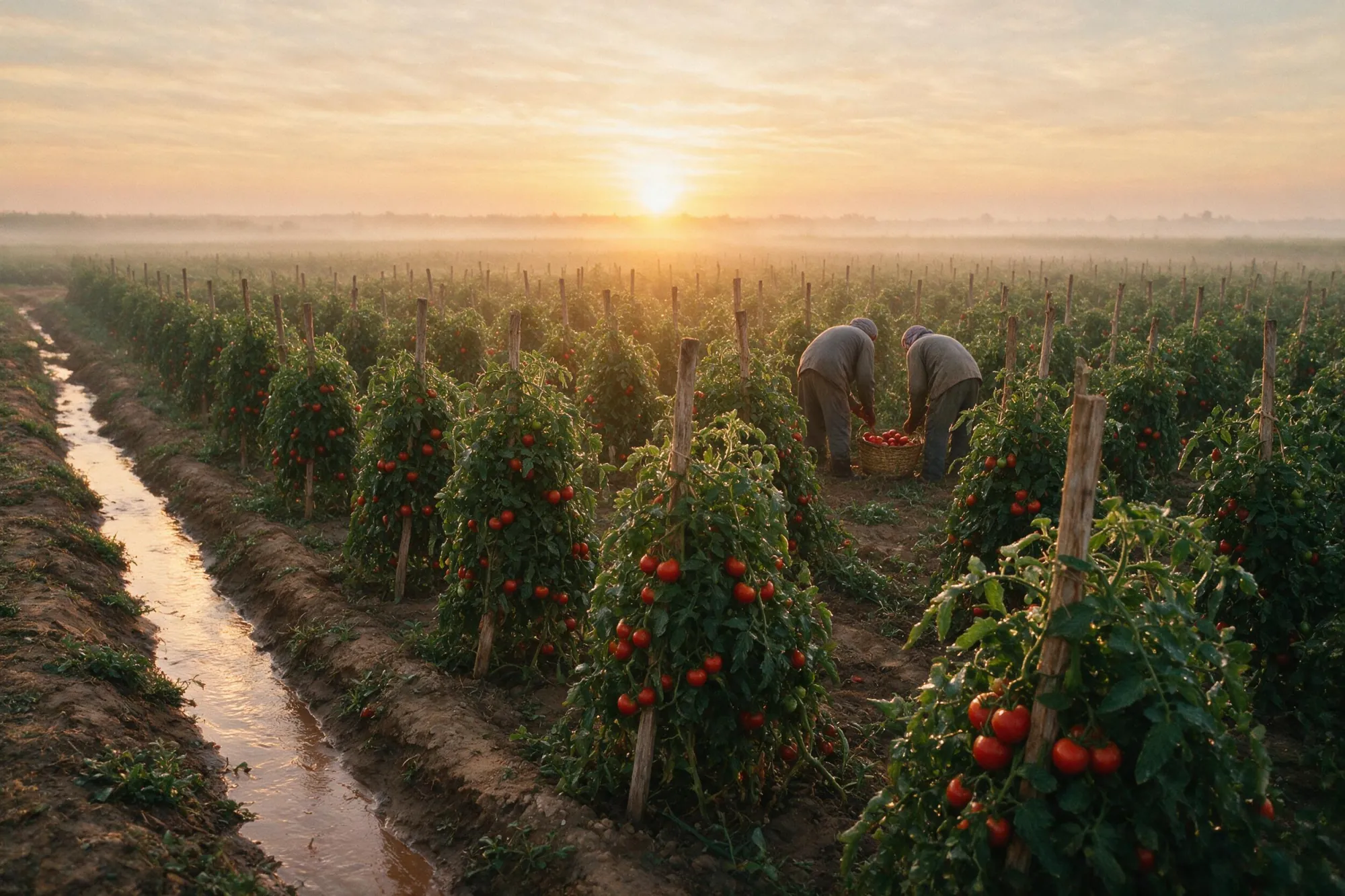
Irrigation practice in the field dwarfs anything a factory meter records.
Most of the water in a tonne of concentrate was spent in the field, long before it reached our meter. That is where the effort has to go.
Where the water actually goes.
For any fruit processor, the overwhelming majority of the water embedded in a tonne of concentrate was used in the field, not on the line. Irrigation dominates the total by an order of magnitude. Any programme that optimises the factory meter while ignoring the farm is optimising the wrong number.
On site: wash, cool, clean, reuse.
Water on a fruit line does four jobs. It carries and washes incoming fruit, it cools product and equipment, it cleans the plant between runs, and it carries away what is left. Each of those has a reuse path if the line is designed for it.
- Counter-current washing — fresh water meets the cleanest fruit at the end of the run and cascades backwards toward the dirtiest intake.
- Condensate recovery — evaporators produce large volumes of clean condensate, which is recovered for boiler feed and site duties rather than discharged.
- Sequenced clean-in-place — the final rinse of one cycle becomes the first flush of the next.
- Effluent treated to irrigation standard — so what leaves the site is an input somewhere rather than a load on the drain.
In the field: drip, mulch, and the right variety.
The leverage in the field is bigger and slower. Drip irrigation instead of flood, mulch to cut evaporation from the soil surface, and varieties matched to the salinity and structure of the land they are planted in — these change the water bill of a crop far more than anything downstream of it.
None of that is adopted for a single season’s buyer. It is why the contracted-grower model and the water programme are the same programme: a farm that knows it has a buyer for the next several seasons can justify the capital that drip irrigation needs.
A farm that knows who is buying in three years’ time will invest in drip irrigation. A farm selling spot will not.
Why sourcing and water are one programme
What is measured today.
Site withdrawal, water per tonne of finished product, condensate recovered and effluent quality are recorded as operational data. They are the raw material for a water figure, not the figure itself.
Water intensity per tonne varies enormously between products and between campaign and off-season, so a single headline litres-per-tonne figure would mislead more than it informs. We will publish banded figures by product once we have full seasons behind them and the ISO 14001 system to verify them.
Alamir Ingredients — Sadat City, Egypt. Questions about anything in this article, or the evidence behind it, go to the export team.
Request a quote Download documentsOther articles.
Sourcing
Shorter fields, lower footprint
Why we contract Egyptian growers before the season instead of buying on the open market.
Read the article → Packaging

Ambient by design
24 months without refrigeration — and the downstream cold chain that removes.
Read the article → People

Two hundred and fifty jobs
What 250 direct jobs in Sadat City consists of, and the skills it builds beyond our payroll.
Read the article →